Dispensary Tech Stack: What to Set Up Before Your First Sale
.png)

Getting a cannabis retail license is a hard-won achievement...which is then rewarded with more work to transform that license into a live dispensary. Somewhere between final inspection and grand opening, every first-time owner runs into the same realization: a dispensary is not a single business, it is a stack of connected systems pretending to be one. The decisions you make about which tools fill those layers — and how cleanly they integrate — quietly determine whether your first month is a marketing story or a recovery operation.
This guide walks through the required dispensary tech stack, in the order it actually needs to come online: the non-negotiable systems that must be running before your first transaction, and the next-90-days layer that compounds the value of everything underneath.
What Is a Dispensary Tech Stack?
A dispensary tech stack is the connected set of software systems that runs your cannabis retail operation, from the moment a customer walks in to the moment payroll runs. In cannabis specifically, the stack also has to enforce regulatory requirements at every layer — purchase limits at the register, state seed-to-sale reporting in inventory, cannabis-aware payment routing, and worker-permit tracking in HR.
A well-connected stack reduces manual data entry, prevents compliance gaps, and gives operators clean data to make decisions with. A disconnected stack creates duplicated work, reporting blind spots, and administrative drag that compounds as you grow. For first-time owners, the most important architectural decision is not which tool to pick in each category — it is making sure the tools you pick actually talk to each other.
Tier 1: Set Up Before Your First Sale
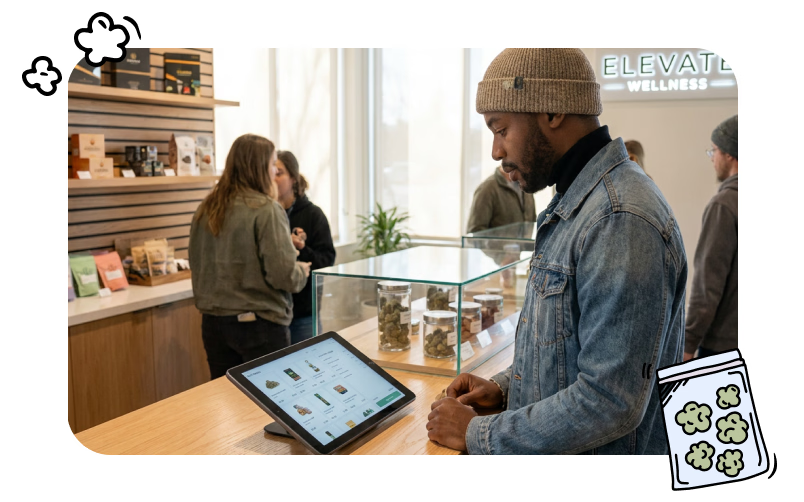
These systems need to be live, configured, and tested before a single legal transaction. Cutting corners here is not a budget decision; it is a regulatory and operational risk. Plan to have all five running and integrated at least two weeks before your soft opening so your team can run real workflows and catch issues before customers do.
1. Point-of-Sale (POS)
Your POS is the single most important system in the stack. It is where compliance, inventory, sales, and customer data converge in real time. A cannabis POS differs from general retail POS because it has to enforce state purchase limits, integrate with the state's seed-to-sale system (typically Metrc), route payments through cannabis-friendly processors, and produce state-specific compliance reports.
KayaPush integrates with six leading cannabis POS platforms so your sales, inventory, and workforce data move together rather than in parallel silos:
- Blaze — full-stack cannabis retail platform with strong delivery and multi-location support.
- Cova — widely adopted across the US and Canada, with deep compliance tooling and a mature reporting suite.
- Dutchie — the largest cannabis e-commerce ecosystem, with tight integration between online menu and in-store POS.
- Flowhub — built specifically for cannabis retailers, focused on compliance, reporting, and operational simplicity.
- Greenline POS — Canadian-rooted with growing US adoption, known for a clean operator experience.
- Treez — enterprise-grade, particularly strong for operators planning to scale to multiple locations.
When evaluating POS options, prioritize one that integrates cleanly with your workforce, accounting, and e-commerce tools. A POS that only talks to itself becomes the bottleneck for every system you add later.
2. Payments and ATM
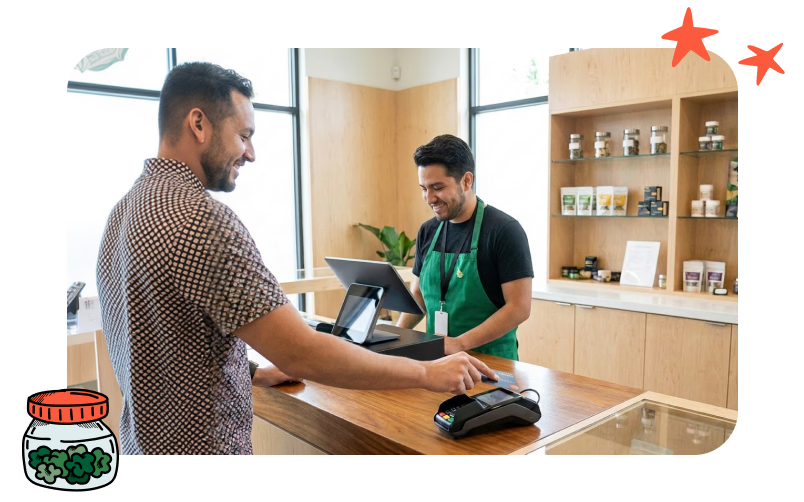
Cannabis payment infrastructure is uniquely complicated because of federal banking restrictions. Most dispensaries operate cash-heavy, and supplement with in-store ATMs, cashless ATM systems, PIN debit, or compliant ACH solutions.
Start the payments conversation early. Sourcing a cannabis-friendly banking relationship and a compliant payment processor often takes weeks or months and is one of the most common reasons opening day gets delayed. Plan for redundancy too — a backup option keeps you operating if your primary processor has an outage.
3. Inventory and State Compliance Tracking
Almost every US adult-use and medical market requires dispensaries to use a state-mandated seed-to-sale tracking system. Metrc is the most widely deployed, with BioTrack and a few state-specific alternatives covering most remaining markets. Your POS will typically integrate with whichever system your state uses.
You also need operational inventory management — receiving, transfers, audit prep, and waste tracking. The key is keeping your day-to-day inventory aligned with what the state sees in real time. Reconciling a discrepancy in week three is far harder than preventing one in week one.
4. Workforce and HR Management
Workforce and HR is the layer where first-time owners most consistently under-invest until they hit a compliance wall. Before opening, you need a system that can onboard staff cleanly (I-9, W-4, state tax documents, cannabis worker permits), track time accurately, run payroll that handles tip income and cannabis-specific tax considerations, and document HR compliance well enough to survive a state audit.
Generic payroll providers can technically process a dispensary's paychecks, but they are not built for the realities of cannabis retail. Cannabis payroll involves tip handling, multi-state wage rules, and a regulatory environment where federal banking limits force creative solutions. HR compliance is even more cannabis-specific: states have their own worker permit requirements, training documentation rules, and retention standards that general HR platforms do not track.
KayaPush is purpose-built for cannabis retail workforce management, combining payroll, time tracking, hiring and onboarding, and HR compliance in a single platform that integrates with all six POS systems above.
5. Security and Surveillance
Cannabis licenses come with strict security requirements: continuous video surveillance, controlled access to limited-access areas, secure storage for product and cash, and incident reporting protocols. A failed security inspection is one of the most common reasons opening day gets pushed.
Get your camera system, access control, alarm monitoring, and safe installed and tested well before your final inspection, and document staff training on incident procedures.
Tier 2: Add Within Your First 90 Days
These systems compound the value of your day-one stack, but are not required for opening. Most operators add them in the first two to three months once transaction data is flowing.
1. E-commerce and Online Menu
Online pre-orders, pickup, and a digital menu are increasingly expected by cannabis consumers. Many POS platforms include e-commerce natively or integrate with specialized providers. You can open without it and add within weeks, but you will leave revenue on the table in markets where customers expect to browse before arriving.
2. Loyalty, CRM, and Marketing
Capture customer data from day one, even if your loyalty program is not fully active. The profiles you build in the first 30 days become the foundation for email and SMS marketing, personalized offers, and lapsed-customer reactivation. A CRM that integrates with your POS turns every transaction into a future opportunity.
3. Accounting and Financial Reporting
Your POS and payroll systems generate the source data, but you need a general ledger system — QuickBooks, Xero, or a cannabis-specialized accounting platform — to consolidate finances and prepare for 280E tax obligations, which limit deductions for cannabis businesses and make clean books materially more valuable than in general retail.
4. Advanced Reporting and Business Intelligence
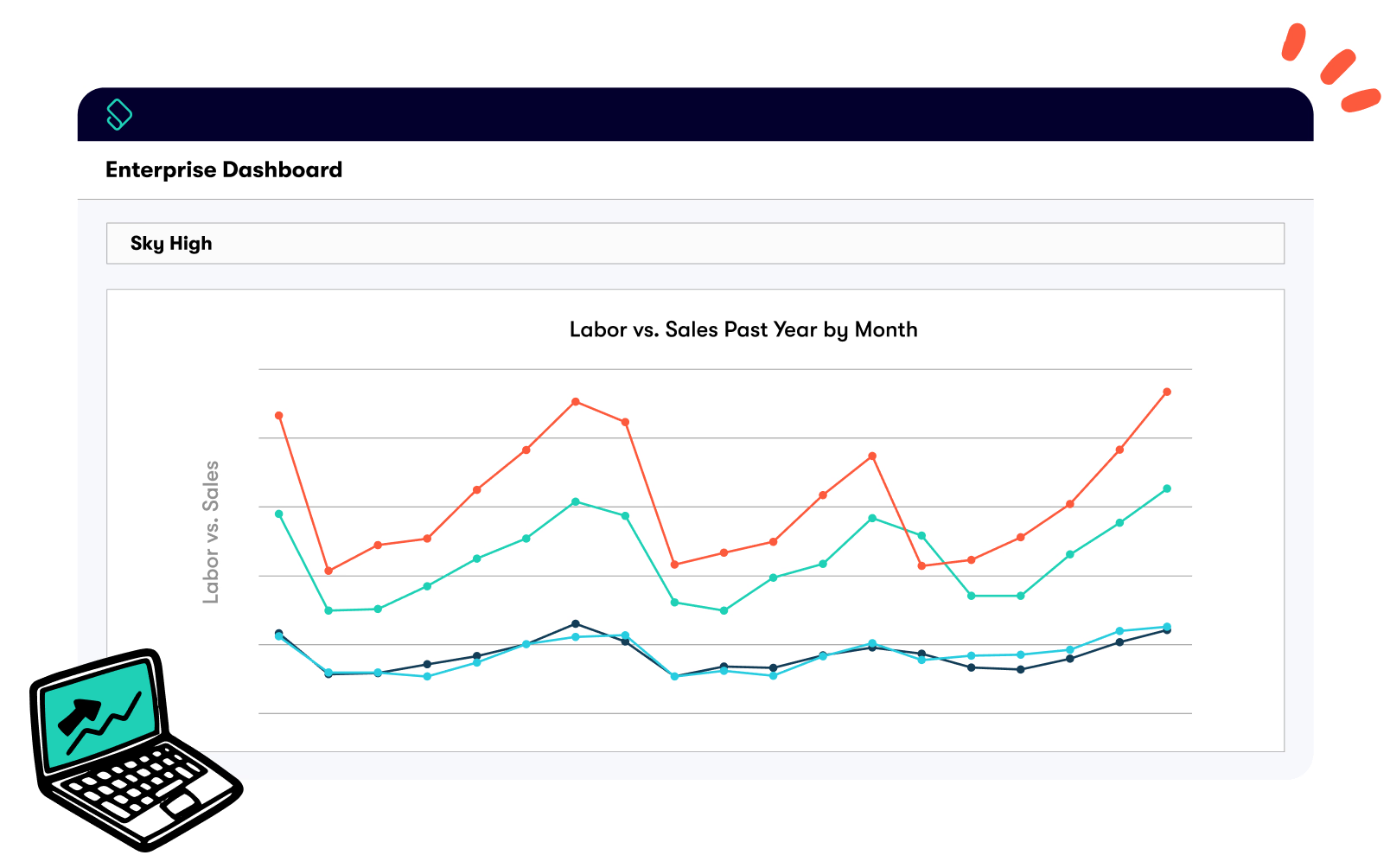
Once you have a month or two of operating data, reporting and BI dashboards become some of the highest-leverage tools in your stack. The metrics that matter most — labor-to-sales ratio, sales per labor hour, gross margin by category — are only useful when sales and workforce data live in the same view.
KayaPush's BI Insights pull workforce data directly from time tracking and overlay it with POS sales data, so operators can see which shifts actually drive profitability. The same numbers also power structured post-event reviews of high-traffic days — see our guide to running a 420 retro for an example.
Common Mistakes First-Time Dispensary Owners Make With Their Tech Stack
Most tech stack regrets are not about which tool was chosen — they are about how the stack was assembled:
- Choosing POS based on price alone. A POS that does not integrate with your workforce, accounting, and e-commerce tools forces manual reconciliation that costs more in operator hours than the license fee ever saved.
- Treating workforce and HR as a launch-week task. Onboarding, time tracking, and payroll need to be configured and tested before your first hire walks through the door.
- Buying tools that do not integrate. Every disconnected system creates a manual handoff, a second source of truth, and a potential audit gap.
- Underestimating cannabis payment setup time. Sourcing a compliant processor is a multi-week process at minimum. Starting 30 days before launch is too late.
- Skipping the test transaction phase. Run real workflows at least two weeks before opening. Smooth launches come from finding integration issues in rehearsal, not in front of customers.
Dispensary Tech Stack FAQs
What is the most important system in a dispensary tech stack?
The point-of-sale system is most important in a dispensary tech stack, because it is where compliance, sales, inventory, and customer data converge in real time. Every other layer depends on the POS being correctly configured and integrated. Workforce management is a close second because it determines whether you can hire, pay, and retain the staff who run the operation.
Can I use general retail POS software for a dispensary?
In nearly all US markets, no. Cannabis retail requires a POS that integrates with the state's seed-to-sale system, enforces purchase limits at the register, routes payments through cannabis-aware processors, and produces state-specific compliance reports. A general retail POS will fail at one or more of those and create regulatory risk.
When should I set up payroll and HR systems?
Before your first hire, not after. Onboarding paperwork, worker permit verification, time tracking configuration, and payroll setup all need to be in place before your first employee starts. Retrofitting after launch is a common source of compliance issues and back-pay disputes.
What is the difference between a state seed-to-sale system and an inventory management tool?
State seed-to-sale systems like Metrc exist for your state regulator to track cannabis from cultivation to retail sale. Operational inventory management is for your team's day-to-day work: receiving, transfers, audit prep, and waste tracking. Your POS typically syncs with the state system automatically.
How much should a first-time dispensary owner budget for their tech stack?
Costs vary significantly by state and feature set, but most first-time single-location operators should plan for a monthly software bill in the low-to-mid four figures once POS, workforce/HR, e-commerce, accounting, and security are all running. The bigger consideration is integration cost — connected tools cost far less to operate than a cheaper disconnected stack.
From License to Launch: Building a Tech Stack That Scales
Getting from license to launch is the most operationally intense stretch a dispensary owner will go through, and the tech decisions made during that stretch become the architecture you operate on for years. The dispensaries that scale most easily prioritize integration from day one, treat workforce and compliance as launch-critical, and pick tools that grow with them.
KayaPush gives first-time cannabis retailers the workforce, payroll, HR compliance, and reporting backbone underneath their POS, so the data you depend on stays connected as you grow from a single store to a multi-location operation.
Ready to launch with a workforce stack built for cannabis from day one? Give your team the payroll, HR compliance, time tracking, and BI tools to scale from your first sale to your hundredth by scheduling a demo with the KayaPush team today.