420 Sales for 2026: Sales Surge, Margin Squeeze

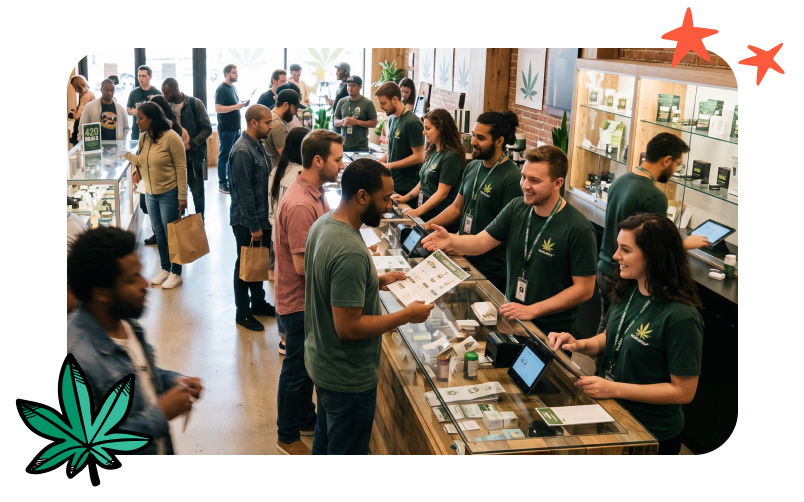
420 landed on a Monday in 2026, but any concern that timing would soften demand proved unfounded. Instead, this year’s celebration reinforced a defining industry trend: 420 is no longer a single-day spike. This year showed that 420 is now a multi-day, high-volume retail event driven by aggressive discounting and increasingly price-sensitive consumers.
From record transaction surges to evolving customer demographics, here’s what the latest data reveals about the 420 weekend (April 18–20, 2026) and what it means for operators moving forward.
Volume Surged, but Revenue Told a Different Story
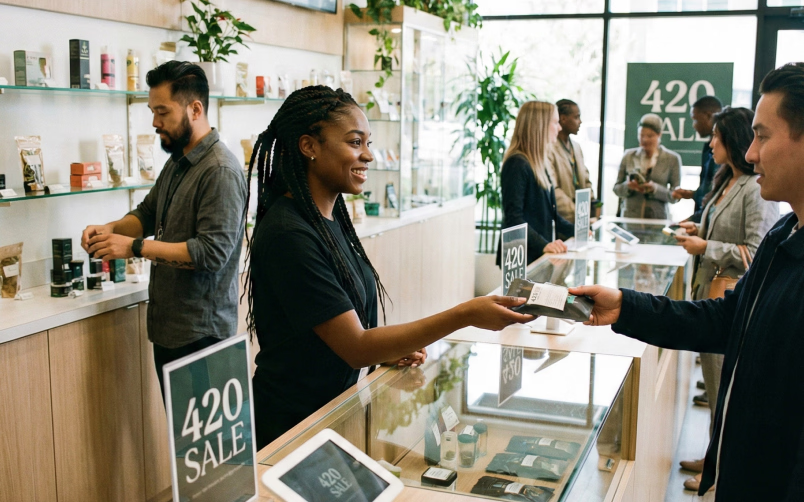
According to early reporting, sales jumped 46.9% year-over-year on April 20, with transactions increasing 46.6%. Other datasets suggest the spike was even more impressive, with some operators reporting sales up to 120% higher than a typical day. Across the full weekend, demand was roughly 48% higher than a standard weekend, with an estimated 13.4 million units sold across tracked U.S. markets.
However, revenue did not scale at the same pace. Average order values declined, as confirmed by retail data analysis. In other words, consumers bought more cannabis products but paid less per item. That gap between unit growth and revenue growth is now becoming the norm for 420.
Discounting: The Engine Behind the Surge
Discounting was the driving force behind the increased volume. Retailers leaned heavily into promotions with remarkable success. Many dispensaries offered 30–40% off storewide deals. Historical benchmarks have already shown 420 discounts averaging around 34%, and 2026 appears to be in line with this.
The result is an increasingly competitive pricing environment that industry observers have described as a “race to the bottom” on pricing. The question for operators becomes one of whether they are maximizing traffic or eroding profitability.
The Rise of the “420 Weekend”
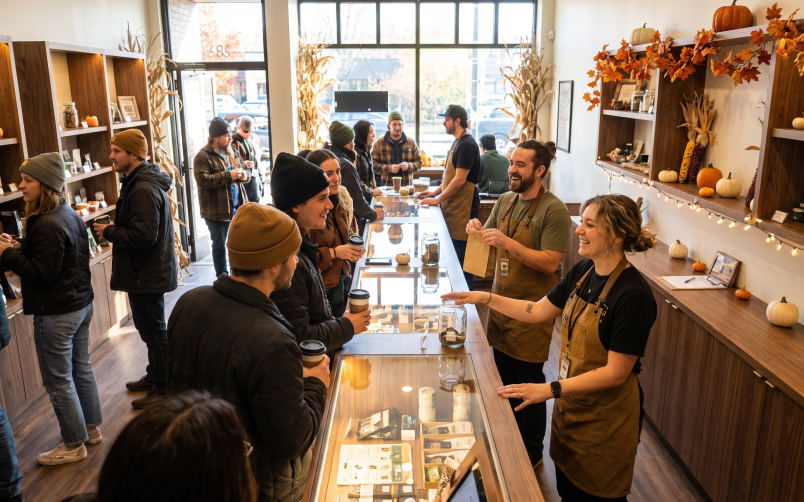
Because April 20 fell on a Monday, retailers doubled down on what has become standard practice: expanding 420 into a multi-day campaign. The most successful operators took certain steps to achieve the best results.
They include:
- Launched promotions as early as Friday, April 18
- Offered early-access deals to loyalty customers
- Extended campaigns into the following week
Interestingly, prior retail analysis shows that the days leading up to 420 often outperform the holiday itself in terms of basket size and profitability. Early shoppers have higher intent to buy and are less discount-driven. While day-of shoppers tend to be more price-sensitive and promotion-driven. This means the day of April 20th no longer represents the spike it once did. Instead, it has become more of a curve.
Top States Lead the Competition
While final rankings are still being compiled, two states are already the standouts for this year’s 420 sales. Michigan and Maryland each succeeded with very different playbooks.
Michigan: The Clear Leader
Michigan continues to dominate through price-driven volume. During the 420 weekend, national demand surged with transactions up roughly 40–50% compared to a typical weekend, with more than 13 million units sold across tracked markets.
Michigan played a major role in that growth, fueled by aggressive discounting that often reached more than 30% and strong traffic from cross-border cannabis tourism. Price gaps of $50–$60 per ounce compared to neighboring states continue to position it as a destination market during high-demand events like 420.
Maryland: Efficiency Over Scale
In contrast, Maryland continues to outperform on efficiency and per-store productivity. Despite a smaller footprint, it ranks among the top states for revenue per location and transaction strength.
While national trends showed declining average order values due to heavy promotions, Maryland operators benefited from more controlled pricing and higher basket consistency. This proves that disciplined pricing and operations can outperform scale, especially during high-volume events.
City-Level Highlights
420 is as much cultural as it is commercial. Key cities continue to reflect that markets that blend experience with retail outperform those relying on discounts alone.
- San Francisco: Despite scaled-back official gatherings, the city still saw strong engagement through smaller, decentralized events and dispensary promotions.
- New York City: With its expanding adult-use market, NYC hosted dense clusters of retail activations and events.
- Las Vegas & Phoenix: Tourism-heavy markets leaned into festival-style retail, combining entertainment, promotions, and high foot traffic.
Core Categories Still Rule
Category-level trends remained consistent in 2026. Top-selling segments included flower, pre-rolls, vapes, and edibles. These categories continue to dominate overall market share. What’s more, 420-specific behaviors reveal certain trends. Pre-roll bundles drive impulse purchases while bulk flower deals increase unit volume. Not surprisingly, edibles attract newer and wellness-focused consumers. This is what results in larger item counts being sold but at a lower value per item.

The Silver Surge Trend
One of the most notable developments in 2026 came from shifting demographics. In parts of California, nearly 60% of 420 shoppers were age 65+. This reflects broader industry evolution due to increased use for pain management, sleep, and wellness, and reduced stigma among older consumers.
For operators, this is more than just a trend. It is a signal that the cannabis consumer base is expanding — and aging.
The 420 Operational Stress Test
While customers see promotions, operators experience something else. It is known as operational strain. During 420 events, cannabis retailers reported the following hiccups:
- POS system slowdowns
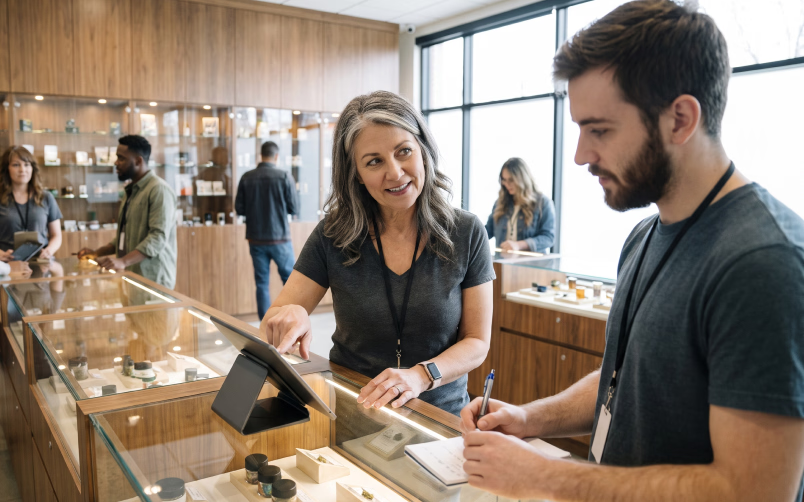
- Long intake and ID verification lines
- Inventory shortages in high-demand SKUs
420 has effectively become a stress test for retail infrastructure, and in a high-volume, low-margin environment, efficiency matters more than ever.
The Bigger Picture: A Maturing Market
420 2026 took place in a rapidly scaling industry. Nearly 15,000 dispensaries now operate in the U.S. The market continues to generate tens of billions in annual revenue. However, growth is no longer driven by novelty. Instead, the industry is shaped by things such as price compression, market saturation, and consumer sophistication. 420 reflects all three forces in real time.
Key Takeaways for Operators
To be a success, not only on 420, but throughout the year, operators need to keep some key points in mind:
- Volume Does Not Equal Profit: Transaction spikes do not guarantee revenue growth when discounting is aggressive.
- Start Early: Pre-420 campaigns often deliver stronger margins and higher basket values.
- Discount Strategically: Blanket promotions may drive traffic, but they erode long-term profitability.
- Experience Matters: Events, education, and in-store engagement create differentiation beyond price.
- New Demographics Are Emerging: Older, wellness-focused consumers are becoming a major growth segment.
- Operations Are Critical: From POS systems to staffing, infrastructure determines success on high-volume days.
Conclusion: 420 Is No Longer Easy
420 is still the cannabis industry’s biggest retail moment but it is no longer a guaranteed win. What used to be a straightforward sales surge has become a complex balancing act between volume, margin, and experience. This is a sign of something bigger. Cannabis is not emerging anymore — it is maturing. For operators, the goal is not just to win 420. It is to use it as a strategic lever for customer acquisition, retention, and sustainable growth throughout the year.