Green Wednesday Staffing: How to Schedule for One of the Busiest Weeks of the Year


Green Wednesday is four weeks out. The promo calendar is probably already drafted: the doorbusters, the bundle deals, the loyalty push. What's usually drafted last, and copied from a normal week, is the schedule.
That's backwards for this particular week. Thanksgiving week runs more customers through the door than almost any other stretch of the year, and it does so at the deepest discounts of the year. The deals bring the traffic. The schedule decides how much of that traffic turns into margin.
Here's what the sales data says about how the week actually behaves, and how to build a schedule and a promo plan that fit it.
What Is Green Wednesday?
Green Wednesday is the day before US Thanksgiving, and the second-largest cannabis sales day of the year after 4/20. In 2026 it falls on November 25. Dispensaries run Black Friday-style promotions, and customers stock up ahead of a long weekend with family. In 2024, average dispensary sales rose 91% over a typical Wednesday on the Dutchie platform, and BDSA measured 1.5x the transactions per store of a normal November day.
The name is a nod to Black Friday, but the week doesn't behave like retail's Black Friday week. It has its own shape, and the schedule needs to match it.
Why Thanksgiving Week Is Won on the Schedule, Not the Deals
Three numbers explain the week.
Traffic rises much faster than basket size. On Green Wednesday 2024, BDSA found transactions per store at 1.5x a typical day but baskets only 1.1x larger. Dutchie saw the same pattern: 91% more sales on a basket that grew 9%, to $70.80. Most of the lift is more people, not bigger orders. More people means more transactions, more ID checks, more time at the counter, and more budtender hours.
Discounts are the deepest of any holiday. BDSA put the average Green Wednesday discount at 28.65% in 2024, deeper than 4/20 or any other holiday period that year. Flower sold through 5% below non-holiday prices even after menu prices were raised beforehand, and edibles sold 10% below. Every transaction that week carries less margin than the same transaction in October.
Thanksgiving Day collapses. Headset data shows Thanksgiving Day sales down as much as 70% against an average Thursday. The week isn't a steady climb. It's a spike, a hole, and then a Black Friday that varies widely by state.
Put those together: the busiest day of the quarter sits next to the quietest, and both are discounted. A schedule copied from a normal week overstaffs Thursday, understaffs Wednesday, and pays full labor on a week where every sale is already marked down. Labor is the one cost in this week you fully control. Inventory is bought, discounts are set, and competitors have published their deals. The schedule is the lever left.
How to Staff Green Wednesday Week
1. Start From Last Year's Hour-by-Hour, Not Last Week's Schedule
Pull last year's Thanksgiving week from your POS by day and by hour. Look at when Green Wednesday peaked, how long the busy stretch ran, how Thursday faded if you were open, and what curve Black Friday followed. That history is your forecast. Build the week's labor plan from it, store by store, and only then adjust for anything that's changed: a new competitor nearby, a bigger promo budget, a market that's matured since last November.
KayaPush Scheduling connects to the POS platforms dispensaries already run on, including Dutchie, Cova, Flowhub, Blaze, Treez, and Greenline, so last year's sales by hour sit next to this year's schedule while you build it.
2. Build Green Wednesday as Its Own Shift Template
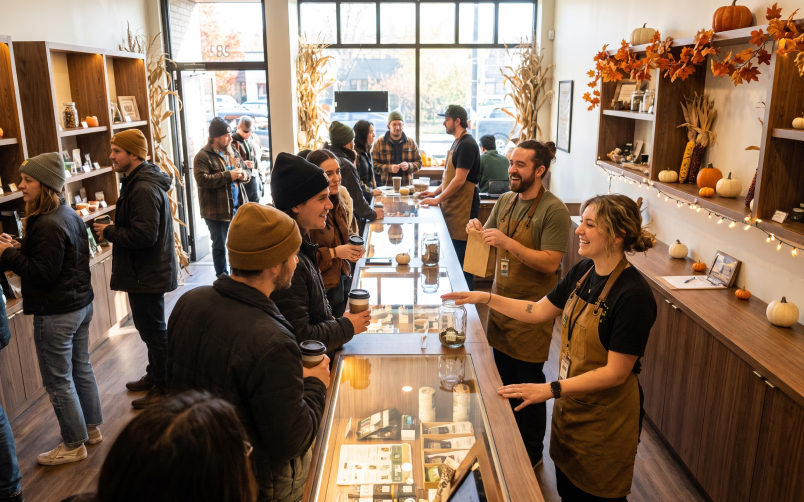
Don't stretch a normal Wednesday to cover it. Build the day from scratch. Stack budtenders on the two peaks, and add roles a normal day doesn't have: a greeter managing the line and checking IDs before the counter, a dedicated online-order runner so pickups don't stall the walk-in queue, and a floater who restocks shelves and covers breaks. Stagger start times in 15-minute increments rather than clean blocks, so coverage builds with the line instead of ahead of it.
Save the template. Next year's Green Wednesday is already on the calendar.
3. Decide Thanksgiving Day on Purpose
Closing on Thanksgiving is a legitimate choice. So is opening for a short morning window to catch last-minute shoppers before the day shuts down. What doesn't work is running a normal Thursday schedule against a day that can do roughly a third of normal sales. Decide which store does what, write it down, and post it to the team before you post the schedule.
4. Treat Black Friday as a Local Question
Nationally, BDSA measured Black Friday 2024 at +60% in incremental sales, a touch below Green Wednesday. But in Michigan, Illinois, and Oregon, Black Friday slightly outperformed Green Wednesday. Headset's 2023 data across several established markets showed Black Friday running 3% to 5% below a normal Friday. The honest answer is that it depends on your state and your customers, and your own POS history settles it faster than any national average. For multi-store operators across markets, the Black Friday schedule may legitimately look different at each location.
5. Brief Budtenders on the Deals Before Tuesday
This is where promo prep and staffing prep meet. A budtender who has to look up whether the bundle applies to the two-pack or the five-pack adds thirty seconds to every transaction, and on a day with 1.5x the transactions, thirty seconds is a longer line and an extra body on the schedule. Hold a short deals briefing before the week starts: what's discounted, what isn't, how the loyalty promo stacks, which slow-moving SKUs you want recommended. That last point also protects margin. Treez's guidance after reviewing shopper visits during a past Thanksgiving week was to discount the products that are slow to sell and limit discounts on best-sellers, because popular items move at full price anyway. Budtenders execute that strategy at the counter, or they don't.
6. Watch Labor Against Sales While the Week Is Happening
The schedule is a plan. The week is what actually happens. Watch labor as a percentage of sales by store and by hour as the days unfold, and cut or add shifts the same afternoon rather than discovering the problem at payroll. KayaPush Time Tracking shows who's clocked in against who was scheduled, and BI Insights put labor next to POS sales by hour and by location, so a store that's overstaffed at 2 p.m. on Thursday is visible at 2 p.m. on Thursday.
Common Green Wednesday Staffing Mistakes
- Copying the previous week. The single most common mistake, and the most expensive. Thanksgiving week doesn't look like any other week.
- Scheduling every store the same. Black Friday in particular behaves differently by state. Let each store's own history set its schedule.
- Treating the deals briefing as optional. Slow transactions on the busiest day of the quarter cost more labor than the briefing takes.
- Reviewing the week in January. Run a short retro the week after, while it's fresh, and save the templates and notes for next year.
Green Wednesday Staffing FAQs
When Is Green Wednesday 2026?
Green Wednesday 2026 is November 25, the day before US Thanksgiving. It's the second-largest cannabis sales day of the year, behind 4/20.
How Much Busier Is Green Wednesday Than a Normal Day?
In 2024, BDSA measured 1.5x the transactions per store compared with a typical November day, and Dutchie reported average dispensary sales up 91% over a normal Wednesday. Basket size rose only about 10%, so most of the lift is more customers.
Should a Dispensary Open on Thanksgiving Day?
It depends on the store. Headset data shows Thanksgiving Day sales down as much as 70% versus a normal Thursday, so a full schedule rarely pays for itself. Closing, or opening for a short morning window, are both reasonable choices. Decide per store, based on last year's numbers.
Is Black Friday Bigger Than Green Wednesday for Dispensaries?
Nationally, no. BDSA measured Black Friday 2024 at +60% in incremental sales versus +66% for Green Wednesday. But in some states, including Michigan, Illinois, and Oregon, Black Friday slightly outperformed. Check your own POS history by store.
Build the Week Around the Margin You Keep
Green Wednesday will be busy whether or not you plan for it. What planning changes is whether the busiest week of the quarter also becomes one of the most profitable, or just one of the most expensive. Build the schedule from last year's hours, give Wednesday its own template, decide Thursday on purpose, and brief the team on the deals before the first customer asks.
Ready to staff Green Wednesday to the real shape of the week? See how KayaPush connects scheduling, time tracking, and BI Insights to the POS your dispensary already runs on by booking a demo with the KayaPush team.