Trump Signs Executive Order Rescheduling Marijuana to Schedule III: What It Means for the Cannabis Industry

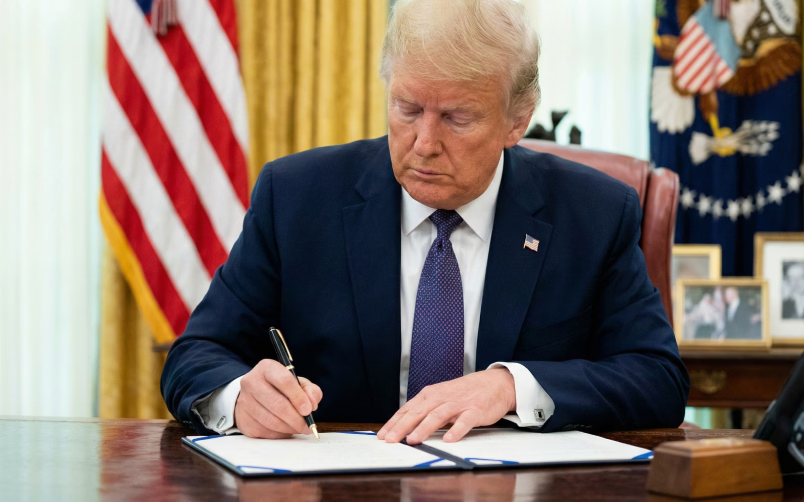
On December 18, 2018, President Donald Trump signed an executive order directing the federal government to move marijuana from Schedule I to Schedule III under the Controlled Substances Act (CSA). This marks a landmark shift in U.S. cannabis policy.
While the order stops well short of federal legalization, it represents the most consequential federal cannabis reform to date. For the legal cannabis industry, the implications are immediate. This reclassification will impact industry standards, including taxation, research, compliance, capital markets, and long-term regulatory risk.
This move aligns with the U.S. Department of Health and Human Services’ prior recommendation that marijuana no longer meets the criteria for Schedule I, and it follows years of pressure from state regulators, industry operators, medical professionals, and investors who argued that federal policy had become untethered from reality.
Understanding What Schedule III Status Means
Under the Controlled Substances Act, drugs are classified into five schedules based on their medical utility and potential for abuse. Schedule I substances, such as heroin, are deemed to have no accepted medical use. Schedule III substances, however, are recognized as having medical value and a lower potential for abuse.
By moving marijuana into Schedule III, the federal government is formally acknowledging that cannabis has accepted medical use in the United States. This alone is historic.
However, Schedule III substances remain federally controlled. They are regulated, monitored, and subject to oversight by the Drug Enforcement Administration (DEA) and, in medical contexts, the Food and Drug Administration (FDA).
The End of 280E for Cannabis Operators
For licensed cannabis businesses, the most significant near-term benefit of this week’s executive order is its impact on Internal Revenue Code Section 280E. Section 280E prohibits businesses that traffic in Schedule I or Schedule II substances from deducting ordinary business expenses like payroll, rent, marketing, and insurance. This provision has forced cannabis operators to pay effective tax rates that often exceed 60–80%.
Because 280E applies only to Schedule I and II substances, marijuana’s reclassification to Schedule III removes cannabis businesses from its scope. What does this mean in practice? It leads to the following changes:
- Immediate improvement in cash flow for plant-touching businesses
- Substantial reduction in effective tax rates
- More accurate financial reporting and forecasting
- Greater reinvestment capacity for hiring, expansion, and price stabilization
- Improved valuation metrics for mergers, acquisitions, and fundraising
For many operators, this change will mean they can shift their focus from survival to sustainability. Of course, the timing of tax relief will depend on implementation details, effective dates, and IRS guidance — areas the industry will be watching closely in the weeks ahead.
Rescheduling Is Not Federal Legalization
Despite the magnitude of today’s announcement, it is critical to understand what the executive order does not do.
Rescheduling marijuana does not:
- Legalize adult-use cannabis at the federal level
- Permit interstate commerce of state-legal cannabis products
- Override any prohibition laws set by individual states
- Automatically protect businesses from federal enforcement
- Create a national retail framework
Federal law still treats non–FDA-approved cannabis as illegal for interstate commercial distribution. State-licensed markets continue to exist in a legally gray area where they are merely tolerated and not embraced by federal authorization.
Research and Medical Use
One of the original justifications for marijuana’s Schedule I status was the claim that it had “no accepted medical use.” That assertion is now officially rejected by the federal government.
As a Schedule III substance, cannabis research becomes materially easier. Universities will face fewer barriers in conducting clinical studies, and there will be more funding available to researchers. Pharmaceutical and biotech companies will also be able to pursue cannabis-derived therapies with clearer regulatory guidelines.
However, this shift also increases the likelihood of greater FDA involvement in cannabis-related products, especially in cases where companies make health or therapeutic claims. The FDA has consistently stated that most cannabis products sold in dispensaries are not approved drugs and may not be marketed with medical claims. They are unlikely to change their stance on this. If anything, it may intensify.
Banking and Finance Progress
Rescheduling marijuana improves the options for cannabis banking, but it does not fully resolve the issue. Banks remain subject to federal anti-money laundering laws and must still assess whether serving cannabis clients exposes them to compliance risk. While Schedule III status may make some financial institutions more comfortable funding cannabis ventures, true normalization of cannabis banking still requires congressional action.
Until federal laws change, the cannabis industry will continue to face cash management issues, selective and expensive lending, and fragmented payment processing options. While the executive order strengthens the policy argument for banking reform, it does not yet replace it.
Capital Markets and Investor Sentiment
Markets respond to signals, and yesterday’s executive order sends a powerful one. By formally acknowledging cannabis as having medical value and removing its most punitive tax burden, the federal government has reduced structural risk for the industry. This is likely to:
- Increase institutional investor interest
- Reignite stalled mergers and acquisitions activity
- Improve access to private credit
- Narrow valuation gaps between cannabis and comparable consumer sectors
That said, capital will continue to favor operators with strong compliance records, clean financials, and scalable systems.
Compliance, Labor, and Operational Discipline
As cannabis moves further into regulatory normalization, the tolerance for “informal” operations will shrink. Operators can expect greater scrutiny during audits and financing rounds. There will be much higher expectations around payroll accuracy, labor compliance, and documentation. It will be even more important that cannabis businesses increase their focus on internal controls and data security.
This is where operational infrastructure matters. Cannabis-specific payroll, scheduling, and compliance systems such as KayaPush will no longer just be nice to have; they will become necessities in a post-280E environment.
For companies evaluating third-party vendors, security posture and regulatory readiness will increasingly factor into procurement decisions as institutional capital joins the cannabis industry.
What Comes Next
Trump’s executive order marks a structural turning point, but not the end of cannabis reform.
Next milestones include:
- Final DEA rule implementation
- IRS guidance on tax treatment
- FDA implementation of product standards
- Congressional action on banking and interstate commerce
- State-level responses and regulatory alignment
The cannabis industry has entered a new phase. It is one defined less by existential survival and more by operational maturity. Those who pivot early will be setting themselves up for long-term sustainability in the market.
Final Takeaway
By signing yesterday’s executive order to move marijuana to Schedule III, President Trump has reshaped the cannabis industry’s economic foundation. The end of 280E alone changes the math for thousands of operators nationwide.
However, this is not a victory lap. It is merely a transition.
The next winners in cannabis will be the companies that treat this moment not as deregulation, but as normalization. Those who invest in compliance, transparency, security, and scalable systems that can withstand increased scrutiny will be ahead of the game.
Learn how KayaPush can streamline your labor compliance and people operations, so you are prepared for the changes coming in 2026 and beyond!